From ketamine to psychedelics
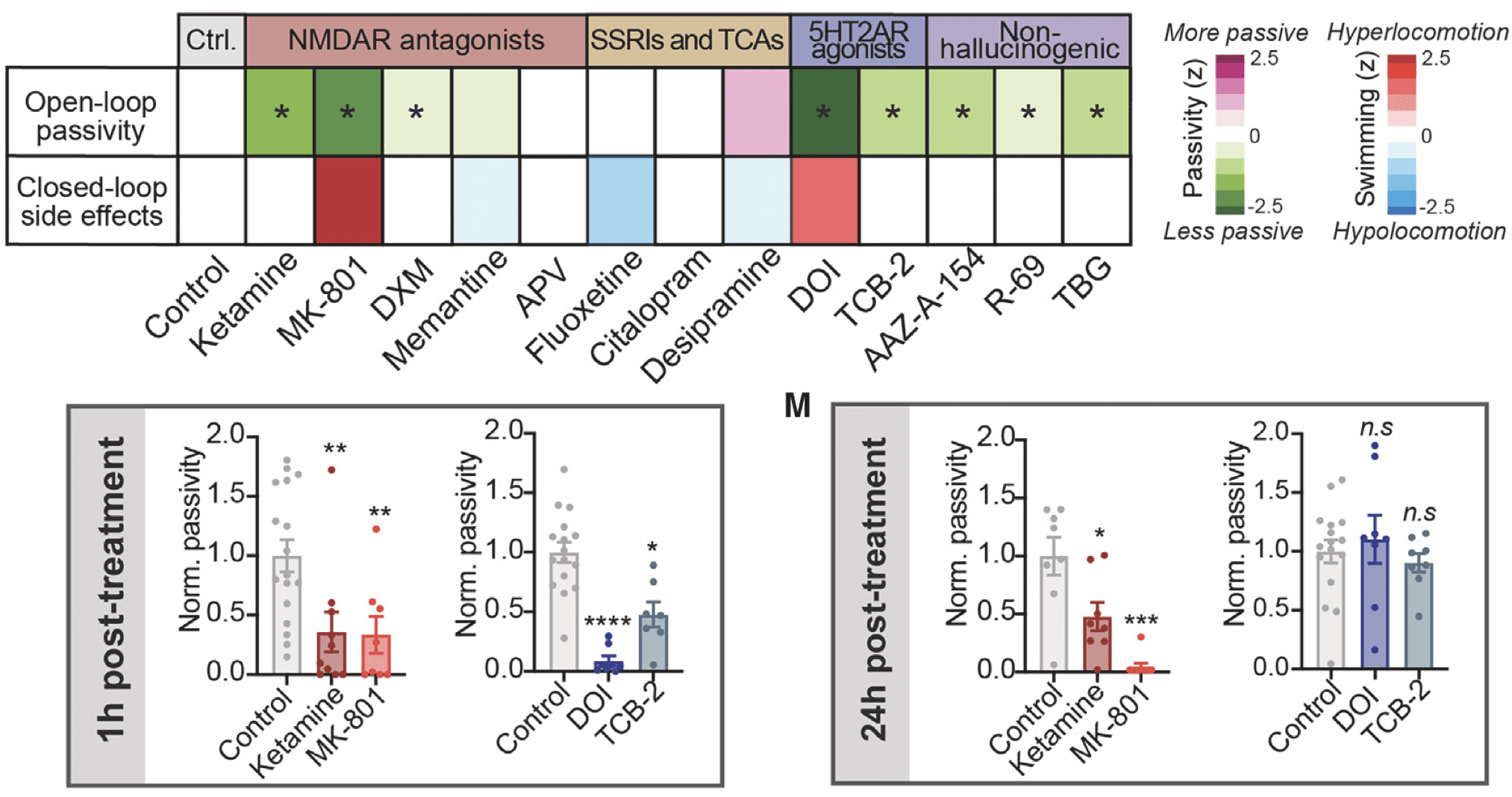
We are also studying how psychedelics, acting through different molecular targets, produce persistent changes in brain and behavioral states, using the same combination of longitudinal behavior and whole-brain imaging.
02
Ketamine · Astroglia · Persistent plasticity
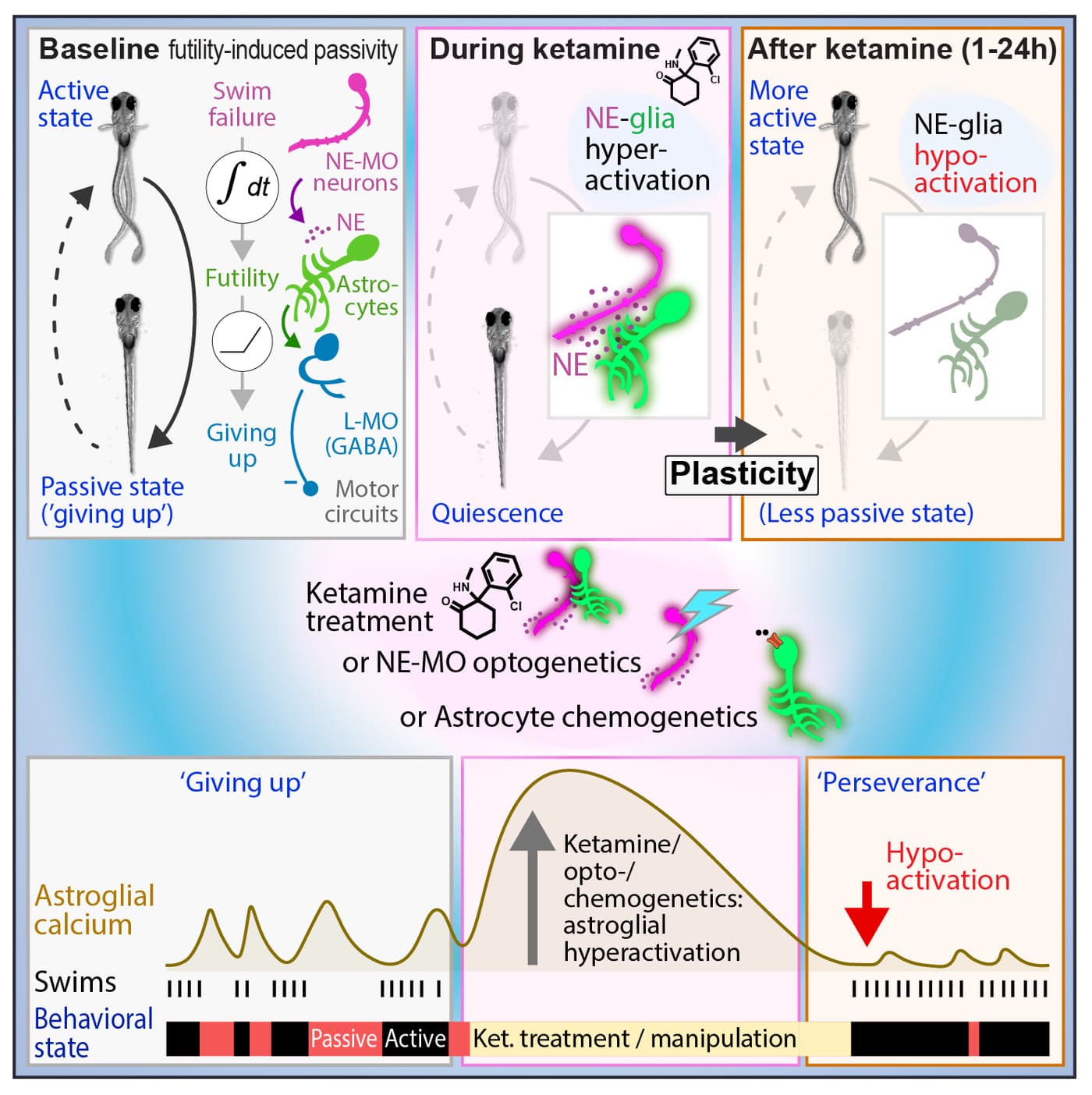
A single ketamine exposure can have long-lasting effects on neural circuit activity and behavior. How?
We combine virtual-reality behavior, whole-brain calcium imaging, pharmacology, and causal perturbations to follow ketamine's effects during exposure and after the drug has been removed.
What we did
We measured behavior before and after a brief ketamine exposure and found a marked decrease in the time spent passive during open loop—when actions are futile—even after washout.
Imaging and perturbation experiments identified a norepinephrine–astroglial component of this persistent effect and showed that ketamine also stimulates astrocytic calcium activity in mammals. Read the paper for the full mechanistic story.
 © Duque et al. 2025
Key papers
Duque et al., Neuron (2025) ↗Current directions
We are also studying how psychedelics, acting through different molecular targets, produce persistent changes in brain and behavioral states, using the same combination of longitudinal behavior and whole-brain imaging.
We are adapting the futility-induced passivity assay into a higher-throughput screen to identify novel compounds with potential antidepressant properties. The larval zebrafish platform uses relatively little compound, allows many conditions to be tested in parallel, and can distinguish effects specific to open-loop futility from general hyperlocomotion and other nonspecific side effects within the same assay. In Duque et al. (2025), we showed that the assay is sensitive to novel non-psychedelic 5-HT2A receptor agonists, including AAZ-A-154, R-69, and TBG.
Methods
PharmacologyCircuit imagingAstroglial signalingQuantitative behaviorMolecular perturbationLongitudinal analysisAntidepressant screeningNext project